

Textile Development for Fashion is an important area of learning for students who want to move beyond fashion sketches and understand how garments are actually created. Fabric influences appearance, comfort, structure, movement, durability and the way a garment can be constructed.
For aspiring fashion students in Pune, textile knowledge can therefore be one of the practical foundations of design education.
Fashion Begins With Understanding Material
A design may look impressive on paper but behave very differently when produced in fabric.
A flowing silhouette may require a material with suitable drape, while a structured garment may need fabric capable of holding its form.
Designers therefore need to ask practical questions
- How heavy is the fabric?
- How does it fall?
- Does it stretch?
- How does it respond to stitching?
- Is it suitable for the intended use?
- How will its texture affect the design?
These decisions directly influence the finished garment.
Fibre Knowledge Helps Explain Fabric Behaviour
Textiles may be made using natural, synthetic or blended fibres.
Different fibres can have different characteristics involving comfort, strength, absorbency, maintenance and appearance.
Fashion students do not necessarily need to become textile engineers, but they should understand enough material science to make informed design decisions.
Fabric Construction Matters
Two fabrics made from similar fibres can behave differently because of how they are constructed.
Woven and knitted materials, for example, have different structural characteristics.
Understanding basic textile construction helps students anticipate how a material may respond during cutting, sewing and wearing.
This can reduce poor fabric choices during garment development.
Surface Development Adds Creative Possibilities
Textile Development for Fashion can also involve changing the appearance or character of a material.
Depending on the programme, students may explore techniques involving texture, embellishment, printing, embroidery or other forms of surface development.
The purpose is not decoration for its own sake. Surface techniques should support the overall garment concept and remain appropriate for the fabric and intended use.
Textile Knowledge Supports Better Garment Construction
Fabric choice affects technical execution.
Some materials are easy for beginners to cut and stitch, while others require greater control. Stretch, thickness, surface texture and directional properties can influence pattern placement and sewing.
Students who understand these characteristics are better prepared to troubleshoot construction problems.
Fashion Students Should Build Material Awareness
One useful learning practice is to maintain a textile reference collection.
Students can record
- Fabric name
- Fibre composition
- Construction
- Texture
- Weight
- Stretch characteristics
- Common applications
- Care considerations
- Observations from cutting and stitching
Over time, this creates a practical reference that connects classroom learning with physical materials.
Why This Matters for Pune's Fashion Learners
Pune has a diverse apparel market that includes boutiques, traditional garments, contemporary fashion, retail brands and custom clothing.
Students preparing for this environment need both creative ideas and an understanding of how those ideas can be produced.
Knowledge of textiles also helps learners communicate more effectively with tailors, garment makers, suppliers and production teams.
What to Look for in Fashion Training
Students considering fashion education should check whether textile study is integrated with practical design and garment-making assignments.
A useful programme should help learners apply material knowledge rather than memorise fabric terminology only.
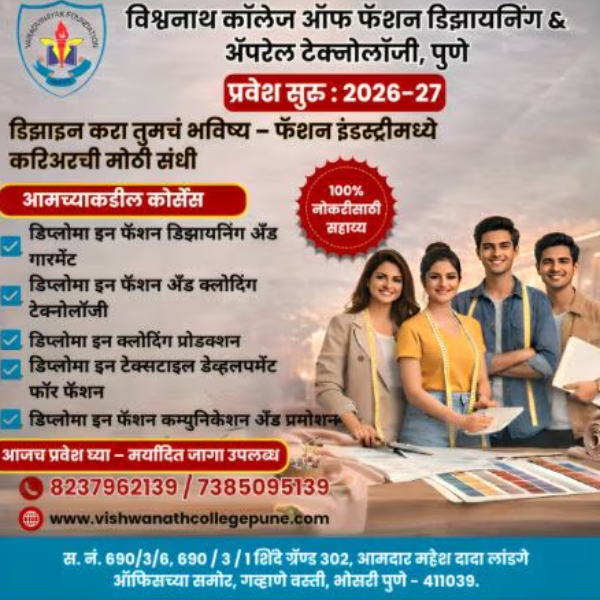
At Vishwanath College in Pune, students exploring career-oriented fashion education can review the current programme structure to understand how textiles, design concepts and practical garment skills are addressed.
Textile Development for Fashion gives students a bridge between creative thinking and physical garment creation. When designers understand what materials can and cannot do, their decisions become more practical, intentional and technically informed.
For students serious about fashion education, learning to observe, compare and work with textiles can be just as important as learning to draw a design.