
A Diploma in Fashion Designing and Garment Making should teach more than how to sketch attractive outfits. Students need to understand how an idea moves from concept to fabric selection, pattern development, cutting, stitching, fitting and final garment construction.
For aspiring fashion students in Pune, comparing programmes on practical learning rather than course names alone can make the selection process more meaningful.
Start With the Curriculum
Fashion programmes can differ substantially.
Some focus heavily on design concepts, while others place greater emphasis on garment construction. Students interested in practical career skills should look for a balanced curriculum.
Relevant areas may include
- Fashion illustration
- Textile fundamentals
- Colour concepts
- Garment construction
- Pattern making
- Measurement
- Cutting techniques
- Sewing methods
- Surface development
- Fashion merchandising basics
The syllabus should help students understand both creativity and execution.
Check How Much Practical Work Is Included
Fashion cannot be learned effectively through theory alone.
A student may create an impressive design on paper but still need the technical knowledge required to convert it into a wearable garment.
Practical sessions should develop confidence in measurement, fabric handling, pattern preparation, cutting, stitching and finishing.
Ask whether students regularly produce actual garments rather than completing only theoretical assignments.
Understand the Importance of Textiles
Different fabrics behave differently during cutting, stitching, draping and wearing.
Students should learn about fibre characteristics, fabric structures, texture, weight, fall and suitability for different garments.
This knowledge helps designers make practical decisions instead of choosing fabric purely for appearance.
Compare Faculty and Learning Support
Beginners often require individual correction while learning garment construction.
A small mistake in measurement or pattern development can affect the final fit. Students therefore benefit when instructors explain not only what went wrong but why it happened.
During an institute visit, ask how practical assignments are reviewed and how students receive feedback.
Look for Portfolio Development
Fashion students often benefit from maintaining evidence of their work.
A portfolio may include illustrations, textile studies, patterns, design development and completed garments.
Building one throughout the programme can help students track their improvement and present their abilities more clearly when exploring further study, internships or work opportunities.
Avoid Choosing Only by Fees
Fees are naturally important, but the lowest-cost course is not automatically the best value.
Compare what is included in the programme. Consider practical hours, equipment access, faculty guidance, course duration and the depth of the syllabus.
Students should also understand whether they will need to purchase fabrics, tools or additional materials for assignments.
Consider the Local Fashion Ecosystem
Pune has boutiques, tailoring businesses, apparel retailers, designers, garment businesses and a large consumer market. Maharashtra also has a substantial textile and apparel ecosystem.
For learners, understanding the commercial side of fashion can be valuable.
A designer may eventually work in garment development, boutique operations, tailoring, styling support, production or other related areas depending on skills and further experience.
Questions Worth Asking Before Admission
Before selecting a Diploma in Fashion Designing and Garment Making, ask
- What practical projects will I complete?
- Does the programme teach pattern making?
- Is garment construction included?
- What textile topics are covered?
- What equipment is available?
- How are practical assignments assessed?
- Will I develop a portfolio?
- What are the current eligibility requirements?
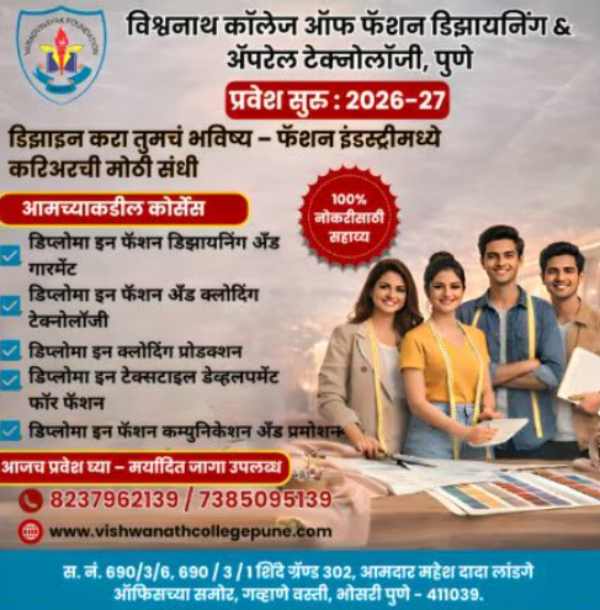
Vishwanath College in Pune provides vocational and career-oriented learning options for students exploring skill-based fields. Fashion aspirants can review the current programme structure and practical-training approach before enrolling.
A strong fashion course should connect imagination with technical execution. Students who understand fabric, patterns, construction and finishing are better positioned to transform creative concepts into garments that actually work.