

Students considering hotel management and catering technology often encounter programmes with similar names but very different learning experiences. Some focus broadly on hotel operations, while others place greater emphasis on food production, catering, service, or practical hospitality skills.
Understanding these differences can help students in Pune make a more informed educational choice.
Start with Your Preferred Career Environment
Hospitality contains several departments.
Before comparing courses, think about where you would prefer to work.
If you enjoy cooking and food preparation, food production may interest you. If you enjoy customer interaction, front office or food service could be more suitable. Students who prefer organisation and operational responsibilities may be interested in housekeeping, catering operations, or related areas.
You do not need to make a lifelong career decision before admission, but understanding these broad differences is useful.
Hotel Management Covers Multiple Functions
Hotel operations involve coordination between departments.
A broad hotel management programme may introduce learners to areas such as:
- Front office
- Housekeeping
- Food production
- Food and beverage service
- Reservations
- Guest relations
- Basic hospitality operations
This multidisciplinary exposure can help students understand how a hotel functions as one connected operation.
Catering Technology Has a Strong Operational Dimension
Catering is not limited to preparing food.
Catering operations may involve planning, quantities, hygiene, kitchen workflow, food service, equipment, storage, and coordination.
Different environments can include institutional catering, event catering, hotel banquets, commercial kitchens, restaurants, and food service operations.
Students interested in this area should look for meaningful practical exposure rather than a curriculum dominated entirely by theory.
Compare Practical Hours
When two courses appear similar, investigate the practical component.
Ask how often students work in training kitchens, service environments, front-office simulations, or other practical facilities relevant to the programme.
Practical sessions can help learners understand:
- Workplace discipline
- Equipment handling
- Service sequence
- Food preparation
- Hygiene
- Team coordination
- Time management
These experiences can also reveal which hospitality department suits the student best.
Check Whether Internships Are Included
Internships can provide exposure to professional hospitality environments.
Students may observe how departments coordinate, how service standards are maintained, and how workplace expectations differ from classroom exercises.
Before enrolling, ask whether internship exposure forms part of the current programme and how it is structured.
Do not assume that an internship automatically converts into permanent employment.
Evaluate Career Support Realistically
A training institute may provide placement-related support, but students should ask exactly what this means.
Useful support can involve interview preparation, resume development, vacancy information, employer interactions, or recruitment opportunities.
Employers ultimately evaluate candidates according to their own criteria.
Communication ability, grooming, practical knowledge, confidence, professional behaviour, and willingness to learn can all influence hospitality recruitment.
Compare Qualifications Rather Than Names
Two courses containing the words hotel management can differ in duration, syllabus, qualification level, eligibility, and intended career pathway.
Compare:
- Entry requirements
- Subjects
- Practical exposure
- Duration
- Assessment
- Qualification awarded
- Internship structure
- Career guidance
This creates a much more useful comparison than relying on course titles.
Hospitality Education in Pune
Pune's hospitality landscape includes hotels, restaurants, cafés, catering operations, event facilities, educational institutions, corporate food services, and other service businesses.
For students across Pune and Maharashtra, studying within a large urban hospitality market can provide useful context for understanding different service formats.
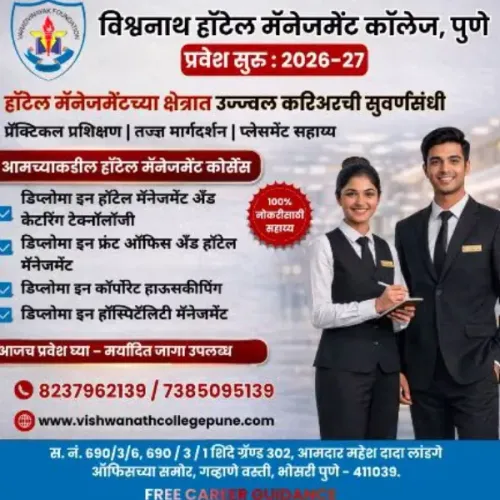
Vishwanath College offers career-oriented programmes in Pune for students exploring vocational pathways, including hospitality-related education. Prospective students should review the current course syllabus and training arrangements before choosing a programme.
Which Type of Student May Benefit?
Hospitality education can suit students who enjoy active work environments and regular interaction with colleagues or customers.
Patience, punctuality, hygiene, communication, teamwork, and professional presentation matter alongside technical skills.
Students should also understand that hospitality can involve shifts, busy service periods, weekends, and operational pressure depending on the workplace.
Choosing hotel management and catering technology education becomes easier when students evaluate the actual work rather than the image of the industry. A programme with balanced theoretical knowledge, practical training, and realistic career preparation can provide a more useful foundation for entering hospitality.