
Choosing the Best ITI Institute in Pune is an important decision for students who want to build practical skills and prepare for technical career opportunities. ITI education is particularly relevant for students who prefer hands-on learning and want to develop competencies that can be applied in workshops, manufacturing units, maintenance departments, construction projects and other technical environments.
Pune has a strong industrial and educational ecosystem, giving students access to different vocational training options. However, an institute should not be selected only because it is conveniently located. The quality and relevance of training deserve closer attention.
Understand the Trade Before Choosing an Institute
Students should first understand what a particular ITI trade involves. Electrician, fitter, mechanic and other technical trades develop different skill sets and lead to different work environments.
Before taking admission, find out
- What subjects are covered
- How much practical training is included
- What tools and equipment students learn to use
- What type of work the trade prepares students for
- Whether the course suits your interests and abilities
A student who understands the trade beforehand can make a more informed decision instead of selecting a course simply because friends have chosen it.
Practical Training Should Be a Priority
Vocational education works best when theory is supported by practical experience.
Students considering an ITI institute should examine the available laboratories, workshops and training facilities. Practical sessions should help learners understand tools, equipment, measurements, safety procedures, fault identification and routine technical tasks relevant to their chosen trade.
Simply memorising technical concepts is not enough for someone preparing for skill-based employment.
Look at the Teaching Approach
Students enter vocational courses with different academic backgrounds. Some may understand technical concepts quickly, while others need demonstrations and repeated practice.
Good instruction should connect classroom concepts with real applications.
For example, electrical students should understand not only definitions but also how components function within an electrical system. Mechanical students should learn why particular maintenance procedures are performed rather than merely remembering a sequence of steps.
Ask About Safety Training
Technical work often involves electrical equipment, machinery, tools, moving components and other workplace hazards.
Safety should therefore be part of everyday technical education.
Students should learn appropriate use of personal protective equipment, safe handling of tools, basic hazard identification, workplace discipline and emergency precautions relevant to their trade.
These habits are useful both during training and later in industrial employment.
Consider Pune's Industrial Environment
Pune and surrounding industrial areas in Maharashtra have substantial activity in automotive, engineering, manufacturing, electrical services, construction and related sectors.
For students, this makes industry-oriented technical skills particularly relevant. Training that reflects actual workplace practices can help learners understand what employers may expect from entry-level technicians and trade professionals.
Students should therefore ask how frequently course content and practical exercises are reviewed against changing industry requirements.
Evaluate the Institute Before Admission
A campus visit can reveal much more than an advertisement.
When evaluating an institute, students and parents can check
- Workshop facilities
- Practical training arrangements
- Faculty experience
- Course structure
- Safety practices
- Student support
- Assessment methods
- Career guidance
- Eligibility requirements
- Course duration and certification details
It is also useful to ask what students are expected to be capable of doing by the end of the programme.
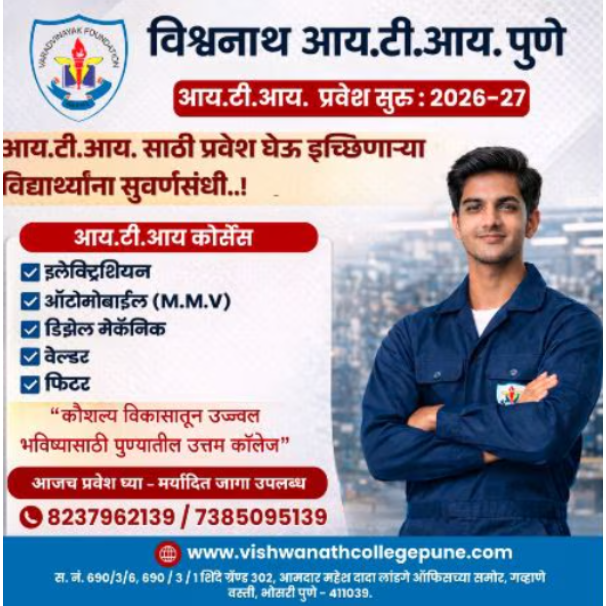
Vishwanath College in Pune offers vocational and career-oriented education for students exploring technical skill development. Prospective students should discuss their educational background, preferred trade and career objectives before deciding which programme fits them.
The Best ITI Institute in Pune for an individual student is ultimately one that combines relevant technical knowledge with meaningful practical exposure. Instead of choosing entirely on the basis of fees, distance or advertising, evaluate how effectively the programme develops usable skills.
A careful decision at the admission stage can help students enter vocational education with clearer expectations and a stronger understanding of the career path they are preparing to pursue.


