

Good pattern making and stitching classes should teach more than how to operate a sewing machine. Students need to understand measurements, pattern development, fabric behaviour, garment assembly, fitting, alterations, and finishing if they want skills that can be applied to practical garment work.
For learners in Pune, evaluating these areas before admission can help distinguish structured vocational training from basic hobby instruction.
Pattern Making Should Be More Than Tracing
Patterns determine the shape and fit of a garment.
Students should gradually understand how measurements are converted into pattern pieces and why specific lines, allowances, and construction details are required.
A useful programme may introduce learners to foundational pattern concepts before progressing toward different garment types.
The emphasis should be on understanding the process rather than repeatedly copying prepared templates without knowing how they were developed.
Measurement Accuracy Is Essential
A small measurement error can become a noticeable fitting problem after a garment is stitched.
Students need practice in taking measurements consistently and using them correctly during pattern preparation.
They should also learn that body measurements are only one part of fit. Garment ease, style, fabric, and construction can influence the finished result.
Stitching Skills Need Progressive Practice
Beginners may start with machine familiarisation and basic stitching before moving toward complete garments.
Training can progressively introduce:
- Seams
- Hems
- Darts
- Facings
- Closures
- Sleeves
- Necklines
- Waist finishes
- Garment assembly
- Finishing techniques
A course should give students enough practice to understand both the technique and the correct sequence of construction.
Students Should Work with Different Fabrics
A technique that works well on one material may be difficult on another.
Fabric weight, stretch, drape, texture, and thickness affect cutting and stitching.
Exposure to different materials helps students learn how to adjust handling and construction methods rather than expecting every fabric to behave identically.
Fitting Practice Separates Basic Sewing from Garment Skill
A completed garment is not necessarily a well-fitted garment.
Students should learn how to observe fitting issues and understand possible causes.
This process connects measurement, pattern making, fabric selection, and construction.
Learning alterations can also be valuable because real customers and garments rarely match a single standard measurement perfectly.
Check the Practical Work Before Enrolling
Students comparing classes in Pune should ask to understand the actual learning progression.
Useful questions include:
- Are patterns drafted by students?
- How many garments are constructed during training?
- Is fitting covered?
- Are alterations taught?
- Are finishing techniques included?
- What machines are available?
- How are practical assignments assessed?
These answers can reveal whether the programme is designed for serious skill development.
Who Is Ready for This Training?
Pattern making and stitching can suit school leavers, students interested in fashion, aspiring boutique professionals, people seeking vocational skills, and learners considering independent garment work.
Patience is important.
Garment construction involves repeated measuring, marking, cutting, stitching, checking, correcting, and finishing. Students expecting instant results may find the process demanding.
Those who enjoy precision and creative problem solving often find the learning process more rewarding.
Career-Oriented Garment Training in Pune
Pune has a large consumer market for garments, tailoring, alterations, boutiques, customised clothing, fashion retail, and related services.
For learners in Maharashtra, garment skills may support employment, further education, or self-employment depending on the qualification and experience developed.
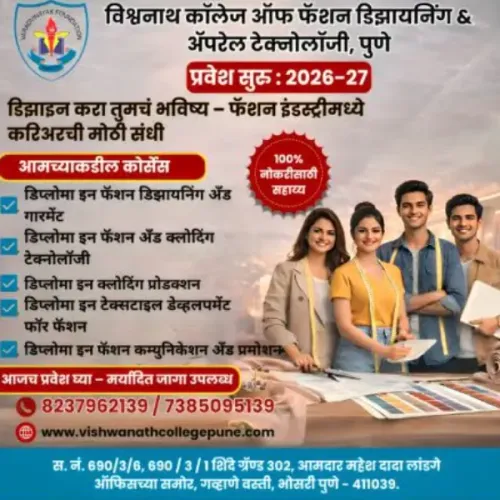
Vishwanath College in Pune offers vocational education for students seeking career-oriented skills. Learners considering pattern and stitching training should examine the current practical syllabus, equipment, course duration, faculty guidance, and progression options before enrolling.
Look for Skills You Can Demonstrate
A useful way to judge vocational fashion education is to ask what you will be able to produce independently after training.
Can you take measurements correctly? Can you draft a basic pattern? Can you cut fabric accurately? Can you assemble a garment in the right sequence? Can you identify fitting issues? Can you finish the garment neatly?
These are concrete learning outcomes.
Pattern making and stitching become career-oriented skills when students understand the complete process rather than isolated sewing techniques. Structured practice, feedback, and repeated garment construction can help learners move from basic machine operation toward more independent clothing work.